The Importance of Time Keeping in Aviation
In this post I explore and discuss the concept of time keeping specifically in aviation. There is a long history of keeping time, and the history of watchmaking is deeply intertwined with aviation. The International Civil Aviation Organization (ICAO) outlines rules for aviation across all member states. Individual member states can make their own special laws, but for the majority of cases, the rules laid out by ICAO are implemented and enforced by all member states. One of these rules is that any pilot is required to have a timepiece with hours, minutes, and seconds hands that works before commencing a flight.
This requirement isn’t arbitrary—accurate timekeeping is fundamental to aviation safety, navigation, and efficiency.
Historical Context: Timekeeping and Flight
The relationship between horology and aviation dates back to the very dawn of powered flight. In 1904, Brazilian aviation pioneer Alberto Santos-Dumont complained to his friend Louis Cartier about the impracticality of using pocket watches while flying. A pilot needed both hands to control the aircraft, making it impossible to retrieve a pocket watch to check time during flight.
Cartier’s solution was revolutionary: he created the Cartier Santos, the first purpose-built pilot’s watch. This square-cased wristwatch, with its exposed screws and distinctive design, allowed Santos-Dumont to keep his hands on the controls while checking time with a simple glance at his wrist. The Santos-Dumont became commercially available in 1911 and is considered the first true pilot’s watch—predating widespread wristwatch adoption by over a decade.
This practical innovation established a principle that continues today: aviation timepieces must be instantly readable without compromising aircraft control.
The tradition continued through aviation’s golden age. When Charles Lindbergh made his historic transatlantic flight in 1927, he relied on a Longines watch for navigation timing. This collaboration led to the creation of the “Hour Angle” watch, designed specifically for aerial navigation using celestial observations; a critical capability for long-distance oceanic flights where ground references were absent.
The “pilot’s watch” as we know it today emerged from these practical requirements:
- Large, legible dials for quick reading during flight
- Luminous hands and markers for night visibility
- Robust construction to withstand vibration and temperature variations
- Precision timekeeping for navigation calculations
Brands like Breitling, IWC, and Omega became synonymous with aviation through their technical innovations and partnerships with pilots and airlines; and we cannot mention Omega here without at least stating the obvious connection with NASA space missions, through their Moonwatch. While many more brands are now demonstrating a connection with aviation, people rarely consider Cartier as one of them, though Louis Cartier and Alberto Santos-Dumont should be considered the pioneers of wristwatches in aviation.
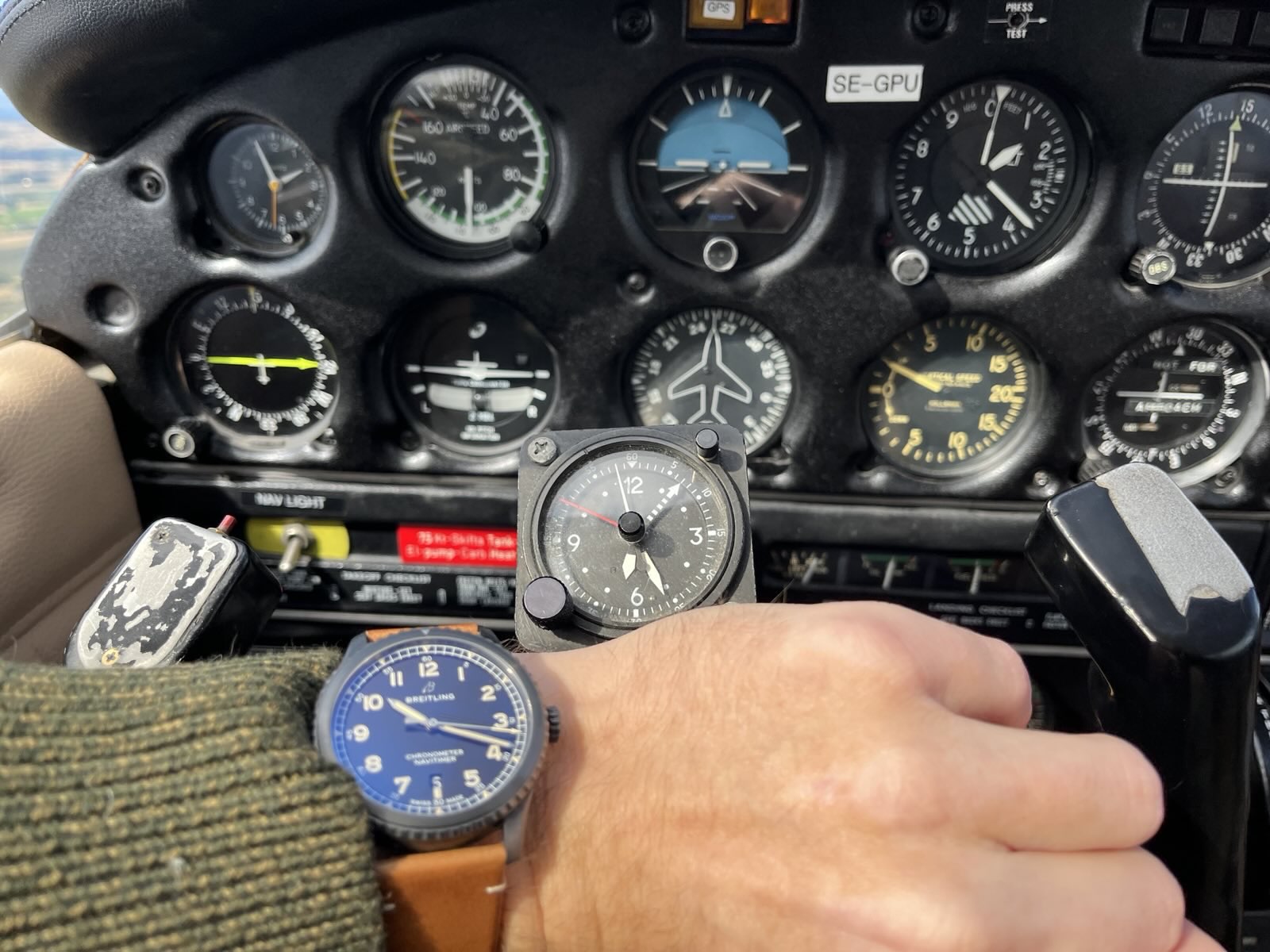 Breitling Navitimer 8 - one of the simplest Navtimer timepieces you can find
The Breitling Navitimer 8 Automatic 41 is truly one of my favorite timepieces. The black DLC coated edition is sturdy, and it does not have a scratch on it to date. I have been using it for at least 3 years, both flying, swimming, fixing engines etc. The more advanced Breitling Navitimer with a circular slide rule, along with their counterparts from Seiko, Citizen, Hamilton, including the E6B flight computer can be a topic for a later post.
Time and Finite Fields
Before diving into the practical applications of timekeeping in aviation, let’s explore a fascinating mathematical connection: the relationship between time measurement and finite field arithmetic—a connection that becomes particularly relevant in modern digital systems of timekeeping.
Modular Arithmetic and Time
Time operates naturally in modular arithmetic. A clock face demonstrates this perfectly, where the hour hand resets at 12 and the minute and second hands reset at 60. If a clock reads 10 o’clock and we add 5 hours, the hour hand lands at 3—the arithmetic wraps around after passing 12. This is exactly the kind of arithmetic that we can handle using modular arithmetic
\[(10 + 5) \equiv 3 \pmod{12},\]which is formally equivalent to working in the finite field $\mathbb{Z}_{12}$ (or $\mathbb{Z}_{24}$ for 24-hour time).
More generally, for any time calculation:
\[t_{\text{future}} = (t_{\text{current}} + \Delta t) \bmod n\]where $n$ is the modulus (12 or 24 for hours, 60 for minutes and seconds).
Cyclic Groups and Timekeeping
The mathematical structure underlying time measurement is that of a cyclic group. The set of hours ${0, 1, 2, \ldots, 11}$ with addition modulo 12 forms a cyclic group of order 12, denoted $\mathbb{Z}_{12}$.
This structure has several important properties:
- Closure: Adding any two times gives another valid time
- Identity: Adding 0 hours doesn’t change the time
- Inverses: Every time $t$ has an inverse $-t$ such that $t + (-t) \equiv 0 \pmod{12}$
- Associativity: Time addition is associative
These properties ensure that time calculations behave consistently and predictably—critical for navigation and flight planning.
Time Zones as Cosets
From a mathematical perspective, time zones can be viewed as right cosets of the cyclic group structure. This is a beautiful example of abstract algebra appearing in everyday aviation operations.
Consider the additive group $(\mathbb{Z}_{24}, +)$ representing hours in a day. UTC time forms the underlying group, and each timezone offset defines a coset decomposition.
For a fixed timezone offset $\Delta t_i$ (e.g., +1 for CET, -5 for EST, +8 for CST), the timezone is a right coset:
\[\text{Timezone}_i = \mathbb{Z}_{24} + \Delta t_i = \{h + \Delta t_i : h \in \mathbb{Z}_{24}\}\]This is a right coset because we’re adding the offset on the right: $h + \Delta t_i$.
Why right cosets, not left?
In the context of time, we read operations left-to-right: “It is currently hour $h$ in UTC, therefore it is hour $h + \Delta t_i$ in timezone $i$.” This makes them right cosets by convention. For abelian groups (like $\mathbb{Z}_{24}$), left and right cosets are identical since $h + \Delta t_i = \Delta t_i + h$, but the conceptual ordering matters for clarity.
Example: European Timezones
Consider three European timezones during standard time:
- UTC (London): $\Delta t_0 = 0$
- CET (Copenhagen): $\Delta t_1 = +1$
- EET (Helsinki): $\Delta t_2 = +2$
These form three distinct right cosets:
\[\begin{aligned} \text{UTC} &= \mathbb{Z}_{24} + 0 = \{0, 1, 2, \ldots, 23\} \\ \text{CET} &= \mathbb{Z}_{24} + 1 = \{1, 2, 3, \ldots, 23, 0\} \\ \text{EET} &= \mathbb{Z}_{24} + 2 = \{2, 3, 4, \ldots, 23, 0, 1\} \end{aligned}\]Note how these are cyclic rotations of each other.
Practical Aviation Implications:
When filing a flight plan from Copenhagen (CET) to London (UTC), you must convert all times:
\[\text{Departure}_{\text{UTC}} = \text{Departure}_{\text{CET}} - 1\]This is coset arithmetic: to go from one coset to another, you add (or subtract) the difference of their offsets:
\[\text{Time}_{\text{UTC}} = \text{Time}_{\text{CET}} + (\Delta t_{\text{UTC}} - \Delta t_{\text{CET}}) = \text{Time}_{\text{CET}} + (0 - 1)\]Quotient Group Structure:
The set of all timezone offsets ${\Delta t_i}$ forms its own group—the quotient group $\mathbb{Z}_{24} / H$ where $H$ is the trivial subgroup ${0}$. In practice, timezone offsets are typically integers (or half-hours like India’s +5.5), forming a discrete subgroup of the real numbers.
The number of distinct timezones is limited by the structure of $\mathbb{Z}_{24}$. With integer offsets, we have at most 24 distinct timezones (in reality, we have more when including half-hour and quarter-hour offsets like Nepal’s +5:45).
Connection to Navigation:
When calculating flight times across timezones, pilots must work within the coset structure. For a flight from New York (UTC-5) to Copenhagen (UTC+1):
\[\begin{aligned} \text{Departure (local)} &: 14{:}00 \text{ EST} = 19{:}00 \text{ UTC} \\ \text{Flight time} &: 7 \text{ hours} \\ \text{Arrival (UTC)} &: 19{:}00 + 7 = 02{:}00 \text{ (next day)} \\ \text{Arrival (local)} &: 02{:}00 + 1 = 03{:}00 \text{ CET} \end{aligned}\]Each step involves coset arithmetic, ensuring consistency across the entire calculation. Obviously, pilots do not generally think of all this as being cosets.
Time Keeping Standards in Aviation
Aviation operates on Coordinated Universal Time (UTC), formerly known as Greenwich Mean Time (GMT). This standardization is critical because:
- Air traffic control coordination across time zones
- Flight planning and scheduling require consistent reference points
- Weather reports and forecasts are issued in UTC (METAR, TAF)
- Navigation calculations depend on precise time
The relationship between local time and UTC is expressed as:
\[\text{Local Time} = \text{UTC} + \Delta t\]where $\Delta t$ is the time zone offset (which can vary due to daylight saving time).
For pilots, the requirement to have a functioning timepiece with a seconds hand serves multiple purposes:
- Navigation checkpoint timing for dead reckoning
- Fuel calculations based on elapsed time
- Measure distances on ground in case of emergency landings in smaller aircraft
There are obviously many more examples. Another watch complication that will have to be a post for later, is the GMT watch which can keep track of multiple time zones.
Navigation: Dead Reckoning and Time
Before GPS, pilots relied heavily on dead reckoning—using time, heading, and speed to estimate position. This method is still taught and required as a backup navigation technique. In most GA flying (EASA) the skill-test requires the student to use this method and not rely on GPS for navigation.
Wind Correction and Time
Wind affects both groundspeed and time calculations. The groundspeed with wind is:
\[GS = TAS \cdot \cos(\theta) + W_h\]where:
- $GS$ = groundspeed
- $TAS$ = true airspeed
- $\theta$ = wind correction angle
- $W_h$ = headwind component (positive for headwind, negative for tailwind)
The wind triangle problem requires solving for heading and groundspeed given:
- True course (TC)
- True airspeed (TAS)
- Wind direction and velocity
This is where precise timing becomes critical. A 10-knot error in wind calculation over a 3-hour flight results in:
\[\Delta d = \Delta v \cdot t = 10 \text{ kts} \times 3 \text{ hrs} = 30 \text{ nm}\]A 30-nautical-mile error could place you significantly off course. Pilots verify their navigation by timing legs between checkpoints and comparing actual vs. planned times.
The Navigation Triangle
The fundamental navigation equation relates distance, groundspeed, and time:
\[d = v \cdot t\]where:
- $d$ = distance traveled (nautical miles)
- $v$ = groundspeed (knots)
- $t$ = time (hours)
Rearranging for time:
\[t = \frac{d}{v}\]Example calculation:
Flying a small aircraft from Malmö (ESMS) to Arlanda (ESSA), a distance of approximately 287 nautical miles. Assuming no significant winds, with a groundspeed of 120 knots. How long will the flight take?
\[t = \frac{287 \text{ nm}}{120 \text{ kts}} = 2.39 \text{ hours} = 2 \text{ hours and } 23 \text{ minutes}\]During this flight, a pilot would note their departure time and verify various positions along the planned path, and use this to confirm flight path accuracy and potentially update ATC about new expected arrival. The weather might change, and this could impact our flight. Assuming we keep the airplane on track, and we note the time properly, we can easily see if we have a crosswind component affecting us negatively or positively. Likewise, ensuring that the endurance of the aircraft is well within safety margins.
Flight Planning: Fuel and Time Critical
Perhaps the most critical application of timekeeping in aviation is fuel planning. There are rules to plan with fuel reserves, and especially in small airplanes, knowing how much fuel is left can be difficult to assess while flying. The gauges are usually not very accurate, but knowing the usual burn rate and adjusting the mixture will help the pilot stay within safety margins.
Fuel Consumption Calculations
Fuel burn is typically measured in gallons per hour (GPH) or liters per hour (L/h). The basic equation is:
\[F_{\text{required}} = \text{Rate} \times t + F_{\text{reserve}}\]where:
- $F_{\text{required}}$ = total fuel needed
- Rate = fuel burn rate (GPH)
- $t$ = estimated flight time (hours)
- $F_{\text{reserve}}$ = mandatory reserve fuel
Example:
Flying a Cessna 172 with fuel burn of 9 GPH on a 2.5-hour cross-country flight:
\[F_{\text{flight}} = 9 \text{ GPH} \times 2.5 \text{ hrs} = 22.5 \text{ gallons}\]VFR day regulations require 30 minutes of reserve fuel:
\[F_{\text{reserve}} = 9 \text{ GPH} \times 0.5 \text{ hrs} = 4.5 \text{ gallons}\] \[F_{\text{total}} = 22.5 + 4.5 = 27 \text{ gallons minimum}\]Many GA pilots add an additional safety margin (e.g., 45-60 minutes reserve). Professional pilots have stricter requirements. Weight and balance calculations is a whole topic in itself, and we will not go into that here, though fuel planning is a bit part of it.
Point of Safe Return
The Point of No Return (PNR) is the furthest point from which you can return to your departure airport with remaining fuel. This calculation depends critically on accurate time and fuel measurements. But as this point is actually not practical for flight planning, given we want and should have fuel reserves when landing, unless we are in an emergency. So we are actually interested in Point of Safe Return (PSR).
For a simple case (no wind), the PNR is:
\[t_{\text{PNR}} = \frac{F_{\text{usable}}}{2 \cdot R}\]where $R$ is fuel burn rate and $F_{\text{usable}}$ is available fuel.
With wind, the calculation becomes more complex but hiding the wind within the ground speed, and if we account for reserve fuel, and consider the endurance
\[\text{E} = \frac{F_{\text{usable}} - F_\text{reserve}}{R},\]we get time to point of safe return to be
\[t_{\text{PSR}} = \frac{\text{E}\cdot\text{GS}_{\text{home}}}{\text{GS}_{\text{out}} + \text{GS}_{\text{home}}},\]where \(\text{GS}_{\text{out}}\) is the ground speed to the point of safe return, and \(\text{GS}_{\text{home}}\) will be the ground speed on the way back. In strong wind conditions, the PSR (and thus PNR) can be surprisingly close to your departure point—sometimes making long over-water flights impossible to perform within safety margins.
Concluding Remarks
The requirement for pilots to carry a functioning timepiece with hours, minutes, and seconds hands is far from arbitrary. It reflects the fundamental role that time plays in:
- Navigation: Dead reckoning, checkpoint timing, position verification
- Safety: Fuel planning, point of no return, measuring potential landing areas on the ground
- Efficiency: ETA calculations, coordination with ATC, operational timing
- Compliance: Following standardized procedures, approach timing, airspace restrictions, log keeping
The mathematics underlying aviation timekeeping demonstrates that accurate time measurement isn’t just convenient, it’s essential for ensuring a safe flight.
The intersection of horology and aviation represents one of the most practical applications of precision engineering. Whether using a vintage mechanical chronograph or a modern GPS-synchronized smartwatch, every pilot depends on accurate time to perform flights safely.
The next time you see a pilot check their watch before flight, remember: they’re not just noting the time. They’re engaging with centuries of horological tradition, mathematical precision, and the fundamental physics that keeps aircraft safely in the sky.
As a private pilot (FAA and EASA) with a deep interest in horology and mathematics, I find the intersection of these fields endlessly fascinating. The precision required in watchmaking parallels the precision required in flight—both demand attention to detail, respect for physics, and an understanding that small errors compound into large problems.
Fly safe, and keep accurate time.